

For most Florida homes, low-voltage lighting is the better choice. It runs at 12V to 24V, has lower shock risk, needs only about 6 inches of burial in many cases, and works well for paths, beds, patios, facades, and most tree lighting.
If you’re choosing between low voltage and line voltage, here’s the short answer:
- Choose low voltage for most home landscape lighting
- Choose line voltage for fixed 120V fixtures like security floods or some building-mounted lights
- Watch wire length on large lots, since 12V runs over 100 to 150 feet can dim
- Use 24V low voltage or heavier wire for longer runs
- Plan for Florida weather with brass or copper fixtures, IP66+ sealing, and surge protection in the $150 to $350 range
- Expect higher install and repair costs with line voltage because permits, conduit, and licensed electrical work are usually required
Florida conditions change the decision. Heat, rain, salt air, storms, wet soil, and pool areas all push many homeowners toward low voltage. Modern LED fixtures also narrow the old brightness gap, so 120V is no longer the default just because more output sounds better.
How to Install Landscape Lighting Like A Pro
sbb-itb-df219b1
Quick Comparison
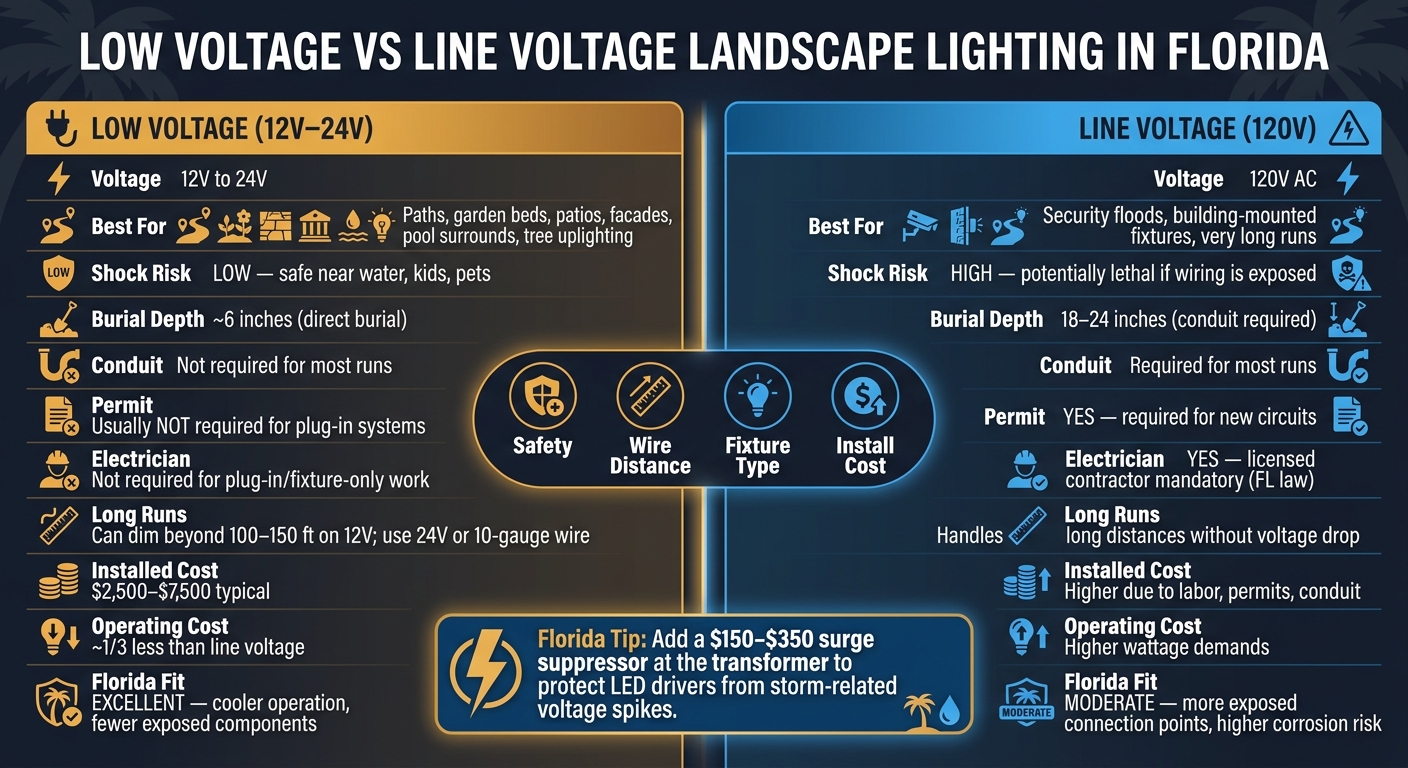
Low Voltage vs Line Voltage Landscape Lighting: Florida Homeowner's Guide
| Criteria | Low Voltage | Line Voltage |
|---|---|---|
| Voltage | 12V to 24V | 120V |
| Best for | Paths, beds, patios, facades, trees, pool surrounds | Security floods, fixed wall fixtures, very long runs |
| Safety | Lower shock risk | Higher shock risk |
| Burial depth | About 6 inches | About 18 to 24 inches |
| Permit needs | Often no permit for plug-in setups | Permit usually required |
| Electrician needed | Often no for fixture-only or plug-in work | Yes, for new permanent circuits |
| Long wire runs | Can lose voltage on big lots | Handles long runs better |
| Florida wet areas | Better fit in many cases | Stricter rules near water |
| Upfront cost | Often lower | Often higher |
| Repair cost | Usually simpler | Often higher due to licensed service |
This comparison comes down to four things: safety, wire distance, fixture type, and install cost. The rest of the article breaks down where each system fits and what matters most on a Florida property.
Where Each System Works Best Around the Property
Once you get past the basics, the main question becomes simple: where should each system go? For most Florida homes, low voltage is the go-to option. It’s safer, easier to tweak later, and simpler to install in shallow trenches. That’s why it handles most residential jobs, while line voltage is usually kept for high-output needs or fixed, permanent setups.
Facades, Pathways, and Garden Beds
For most curb appeal lighting, low voltage is the smart pick. Along walkways, path lights spaced 8 to 10 feet apart on alternating sides help create even, glare-free coverage.
In garden beds, low-voltage fixtures fit neatly between shrubs and stay safe to touch, even in wet mulch. For façade washing, low voltage also works well when you want controlled beams and warm light around 2,700K. Line voltage makes more sense only when you’re lighting very tall features or broad surfaces that need the most output.
Patios, Pergolas, and Outdoor Living Areas
Patios and pergolas usually look best with layered light that doesn’t blast people in the eyes. That’s an area where low voltage does a good job. In Florida outdoor living spaces, it gives you controlled, layered light without harsh glare, especially in covered pergolas and open seating areas.
Line voltage has its place here too, mainly for wall-mounted sconces and security fixtures that tie straight into the home’s electrical system. Those fixtures connect to the breaker panel and fit permanent architectural uses better.
Tree Lighting and Long Wiring Runs
For Florida specimen trees like Sabal Palms and Live Oaks, you often don’t need a massive fixture to get a strong effect. A single 7W LED low-voltage uplight placed 18 to 24 inches from the base at a 45-degree angle is usually enough to create a dramatic look. In most cases, Florida tree canopies don’t call for the higher output of line voltage.
Where low voltage starts to get tricky is wire distance. On a standard 12V system, runs longer than 100 to 150 feet can lead to visible dimming and color shift once voltage drops below 10.8 volts.
There are two common fixes:
- Use 10-gauge copper wire on longer runs
- Move up to a 24V system, which is common on larger Central Florida estates like Windermere or Isleworth
If the run is extremely long and even brightness across the whole property can’t slip at all, line voltage is often the cleaner answer. Brightness is one part of the picture, but install demands and code rules also shape how simple each system is to use.
| Property Area | Preferred System | Key Reason |
|---|---|---|
| Pathways & Driveways | Low Voltage | Easy to route around existing beds |
| Garden & Planting Beds | Low Voltage | Safe in wet mulch |
| Pool & Spa Surrounds | Low Voltage | Safe near water |
| Facades & Wall Washing | Low Voltage | Controlled beam |
| Patios & Pergolas | Low Voltage | Glare-free layered light |
| Specimen Palms & Oaks | Low Voltage (24V on large lots) | Long-run stability |
| Security Floodlights | Line Voltage | High-intensity output |
| Building-Mounted Fixtures | Line Voltage | Direct panel connection |
Safety, Installation, and Code Differences
The gap between low voltage and line voltage isn't just about brightness or fixture type. It also comes down to shock risk, permit rules, and how fixed the system needs to be.
Once you know where the lights will go, those are the next things that matter.
Why Low Voltage Is the Standard for Residential Landscape Lighting
Low-voltage lighting runs at 12V to 24V, so the shock risk is low, even around wet areas. That's a big reason it's the go-to choice for residential yards, especially where there are kids, pets, and irrigation lines.
Installation is simpler too. Direct-burial cable usually needs to be buried only 6 inches deep, and conduit is usually used only when the wire crosses hardscape.
Florida law also gives homeowners some room here. Florida Statute §489.503 exempts homeowners from licensing for factory-cord-and-plug low-voltage systems connected to an existing outdoor GFCI outlet. That said, lighting near pools, spas, and fountains within 20 feet must follow NEC Article 680 and needs a permit plus a licensed contractor.
That mix of lower risk and simpler installation is why low-voltage systems show up in most residential landscape lighting projects.
What Line Voltage Installation Actually Involves
Line voltage runs at 120V AC, which changes the stakes. If the wiring gets damaged and exposed, the shock hazard is serious.
Permanent outdoor 120V circuits also bring stricter legal and installation rules. In Florida, this kind of work requires a licensed electrical contractor and a permit. Unlicensed work on a permanent 120V system is a second-degree misdemeanor.
The installation itself is heavier-duty too. Line-voltage runs need:
- Conduit
- Weatherproof junction boxes
- Burial depths of 18 to 24 inches, depending on the setup
| Factor | Low Voltage (12V–24V) | Line Voltage (120V) |
|---|---|---|
| Shock Risk | Minimal; low risk near water, pets, kids | Serious; potentially lethal if exposed |
| Burial Depth | 6 inches (direct burial) | 18–24 inches (conduit required) |
| Conduit | Not required for most runs | Required for most runs |
| Licensing | Exempt for plug-in systems (FS §489.503) | Licensed electrician mandatory |
| Permit Required | Usually no for plug-in systems | Yes, for new circuits |
| Pool Proximity | Safer; preferred for pool surrounds | Strict NEC Article 680 setbacks apply |
One more thing worth planning for: many pro installers add a $150 to $350 surge suppressor at the transformer. In Florida, that helps protect LED drivers from storm-related power spikes.
Brightness, Durability, Maintenance, and Cost in Florida
Brightness Levels and Fixture Types
Once you’ve nailed down placement, light output and beam spread shape the final look. And this is where LED lighting has changed the game.
Modern LEDs have mostly erased line voltage’s old edge on brightness. Low-voltage systems can now produce the same lumen output while using far less wattage. They also give you better control over where the light goes, with more beam spread options than line-voltage fixtures.
That matters because outdoor lighting isn’t just about making things bright. It’s about putting light in the right place. A tight beam can highlight a palm trunk or entry detail. A wider beam can wash a wall or light up a planting bed.
Line voltage still has its place, though. It works well for high-intensity security lighting, large flood lighting, and very tall features where sheer output matters more than beam control.
How Florida's Climate Affects Each System
Brightness only helps if the fixtures can survive Florida weather.
Salt air, heavy rain, high water tables, and harsh UV exposure put outdoor lighting through a lot. Over time, the biggest difference usually comes down to materials and sealing.
In coastal areas, standard aluminum and 304 stainless steel can corrode fast, while solid brass or copper fixtures age into a patina instead of pitting. If the property sits within 1,000 feet of saltwater, marine-grade 316 stainless steel hardware is the minimum.
Sealing matters just as much. An IP66 rating or higher helps keep out tropical rain and irrigation overspray. For buried cable, use UL Type UF or another wet-location-rated option, since Florida’s sandy soil and high water tables can leave cable runs sitting in water after a heavy storm.
Low-voltage systems also run cooler and are safer in wet conditions, which gives them an edge in Florida.
Line-voltage systems have more exposed connection points, conduit joints, and weatherproof boxes. More parts out in the elements usually means more chances for corrosion and harder repairs later.
Maintenance Needs and Budget Expectations
Long-term cost isn’t just about what you pay on install day. It also comes from what the system needs year after year.
Low-voltage lighting is usually simpler to maintain. In Florida, the regular jobs are pretty straightforward:
- Storm checks
- Re-aiming fixtures
- Trimming fast-growing plants like viburnum and ixora every 3 to 6 months so they don’t block the beam path
After major storms, check for leaning fixtures, buried path lights, lens fogging, and loose waterproof caps or splices.
Line-voltage systems are a different story. Most repairs need a licensed electrician, including work on junction boxes, conduit, and 120V connections after storm damage. That pushes repair costs up almost any time something goes wrong.
On price, standard professional low-voltage systems usually land in the $2,500 to $7,500 range, while estate-scale projects cost more. Line-voltage installations usually cost more because of extra labor, permits, and install demands.
| Factor | Low Voltage (12V–24V) | Line Voltage (120V) |
|---|---|---|
| Beam Control | Precise; many beam angles | Wide, less controlled spread |
| Durability in Florida | Cooler operation; fewer vulnerable components | More exposed connection points; higher corrosion risk |
| Maintenance | Simple storm checks and re-aiming | Most repairs require a licensed electrician |
| Installed Cost | Typically $2,500 to $7,500 | Higher due to labor and permit costs |
| Operating Cost | About one-third less than line-voltage systems | Higher due to wattage demands |
One budget item Florida homeowners shouldn’t skip is surge protection. A surge suppressor at the transformer usually costs $150 to $350 and helps protect LED drivers and smart controllers from storm-related voltage spikes. In a state where afternoon storms can hit hard, that’s something to plan for upfront.
Which System Fits Your Florida Property
For most Florida homes, low voltage is the better fit for landscape lighting projects. It's safer around pools and other wet areas, and it's usually easier to service over time. With modern LED low-voltage fixtures, you can get more than enough light for accent lighting, pathways, and garden areas, so line voltage is often more than most homes need.
Line voltage makes sense when the fixture needs to function like a fixed part of the home's electrical system. That usually means things like permanent wall-mounted fixtures, high-output security lights, or large spaces where maximum brightness is the main goal. In most other cases, it adds extra cost and more installation work without giving homeowners much in return.
One thing people often miss: the setup can look fine during the day and feel completely off at night. That's why an after-dark walkthrough matters before installation is finalized. Beam spread, shadows, glare, and light spill don't show their full effect until the sun is down. At Well Lit, that nighttime review is a standard part of the process, helping catch issues early so the plan can be adjusted before the job is locked in.
FAQs
How do I know if 12V is enough for my yard?
A 12V system is usually enough for residential landscape lighting. It works well for pathways, garden beds, deck accents, architectural features, and tree uplighting.
For most Florida homes, it’s the standard pick because it’s safer, easier to install, and uses less power.
Choose 12V if you want to avoid the permits and licensed electrician that 120V systems often require. Just make sure the total wattage of your fixtures stays within your transformer’s capacity. And if your wire runs go past 100 feet, use the proper wire gauge so the system performs the way it should.
Can I mix low voltage and line voltage on one property?
Yes. You can use both on the same property, but they stay separate systems and each one has its own installation rules.
Low voltage (12V or 24V) is common for path lights and accent uplighting. Line voltage (120V) is usually used for higher-output fixtures, like large floodlights or area lighting. It also calls for a licensed electrician, conduit, and specific burial depths.
What should I ask before installing lights near a pool?
Ask whether the fixtures have a UL wet-location listing. Also ask whether all direct-bury cable is rated for wet locations, which matters even more in Florida’s humid conditions and sandy soil that’s often saturated.
You’ll also want to confirm that the transformer uses a GFCI-protected outlet. On top of that, it should be mounted at least 12 inches above grade and placed away from sprinkler spray and roof runoff.
Related Blog Posts
Request your quote and we'll show you what your yard can become after dark. You'll get a custom lighting design built around your home, a straightforward price with no surprises, and outdoor audio too if you want the space to sound as good as it looks.
No pressure and no obligation. Just honest answers from a family-run team that treats your property like our own and helps you make the right call.
Book an Appointment
We have received your estimate request and will be reaching out to you shortly.