
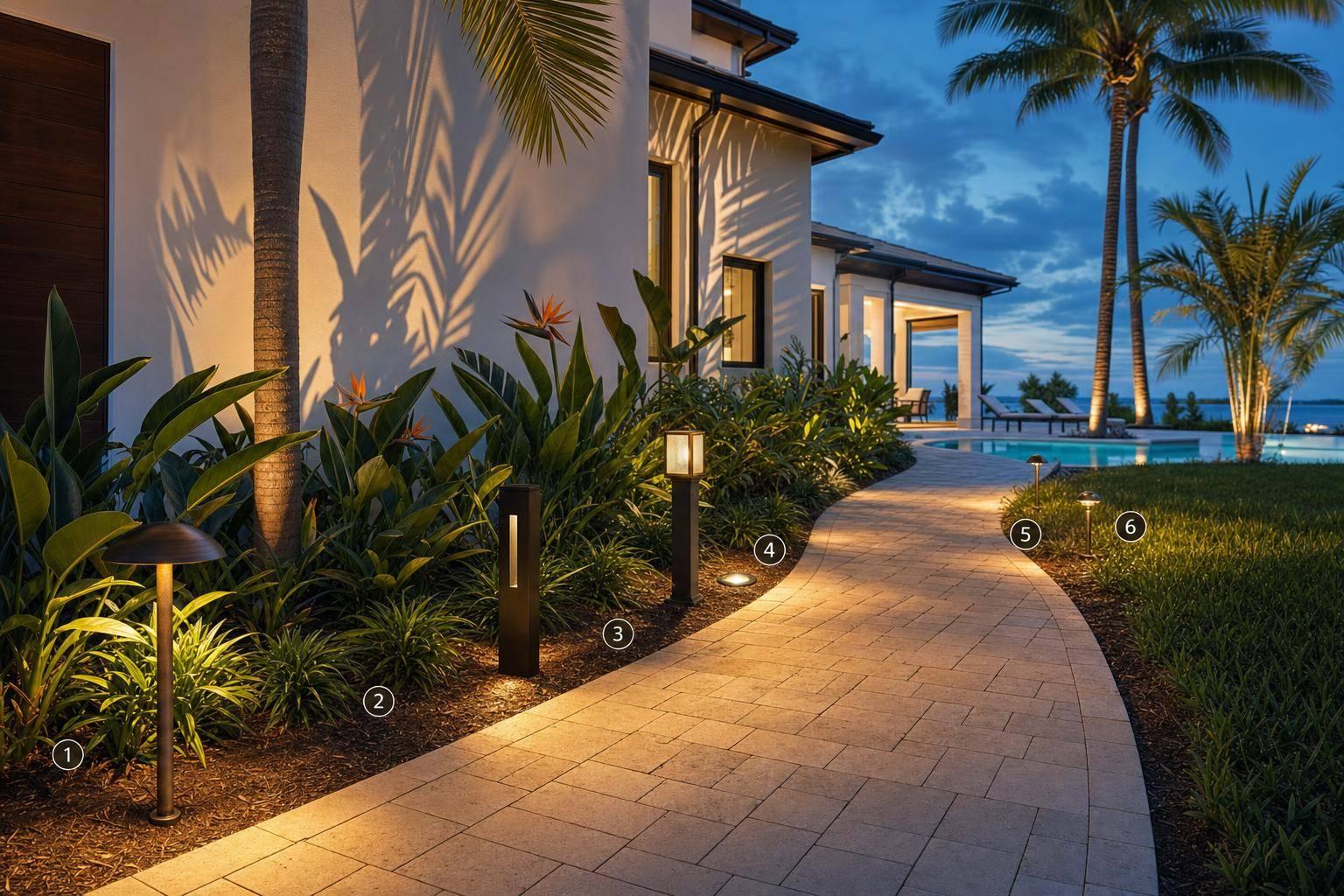

The best pathway lighting depends on your yard size, home style, glare needs, and Florida weather. For most homes, low-profile path lights work well for front walks, bollards fit driveways and long paths, recessed lights suit steps and pool decks, lantern fixtures add more daytime style, clean-line path lights fit modern homes, and downlighting works best when trees or eaves are already in place.
If you need a short answer, here it is:
- Use low-profile lights for simple, ground-level path lighting
- Use bollards for more coverage and a stronger visual marker
- Use recessed edge lights for a flush look on hardscape edges and stairs
- Use lantern-style fixtures when curb appeal matters as much as lighting
- Use modern path lights for clean-lined homes and patios
- Use downlighting when you want soft light from above with fewer ground fixtures
Florida conditions matter just as much as style. Salt air, heavy rain, sandy soil, and storm season can wear out cheap fixtures fast. That’s why IP65+ protection and metals like brass, copper, or marine-grade stainless steel matter. Most walkway lighting also looks best at 2,700K to 3,000K, which gives off a softer light and can draw fewer bugs than cooler LEDs.
Recommended Path Lights - Best and Worst Features (Landscape Lighting)
sbb-itb-df219b1
Quick Comparison
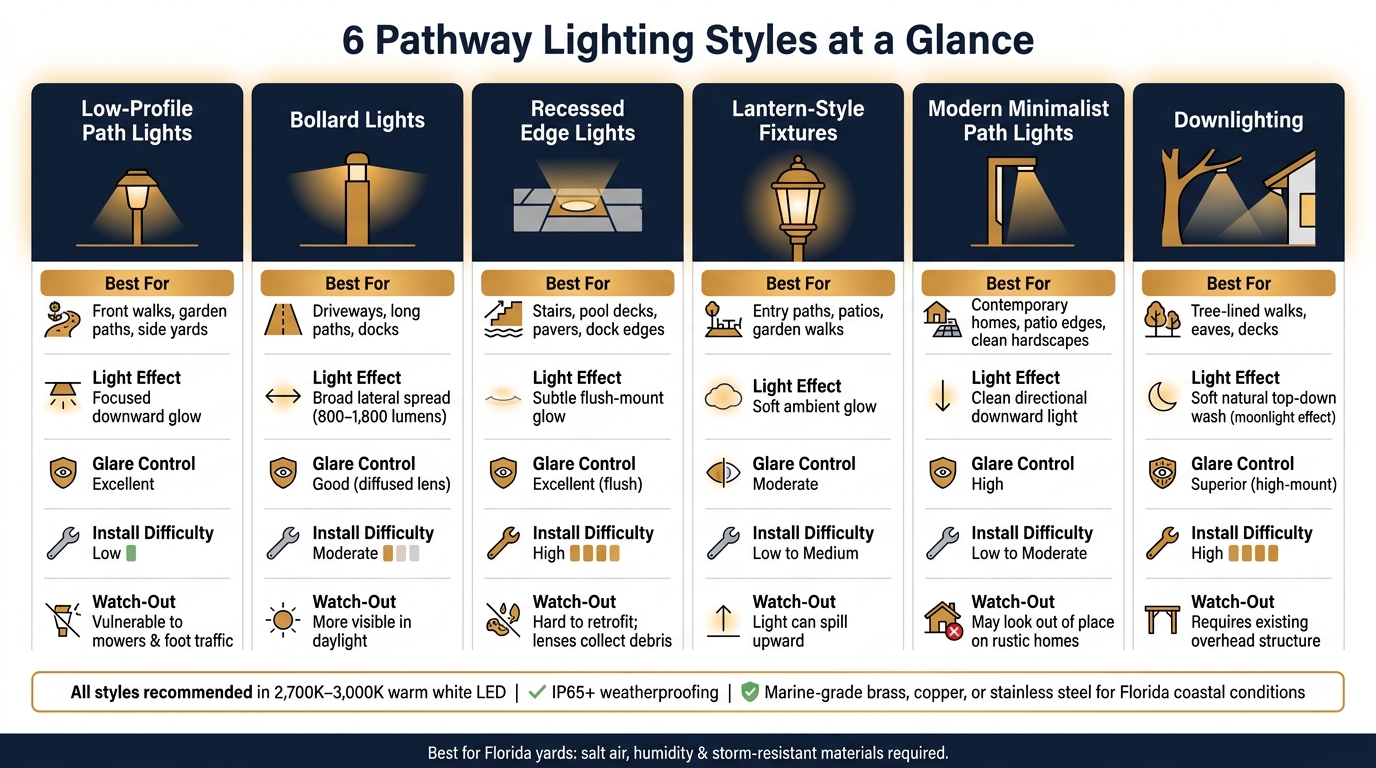
6 Pathway Lighting Styles: Quick Comparison Guide
| Style | Best For | Main Light Effect | Main Watch-Out |
|---|---|---|---|
| Low-profile path lights | Front walks, side yards, garden paths | Soft downward light | Can take hits from mowers or foot traffic |
| Bollard lights | Driveways, long paths, docks | Broader light spread | More visible during the day |
| Recessed edge lights | Stairs, pool decks, pavers, dock edges | Flush, low-glare guide light | Harder to install or retrofit |
| Lantern-style fixtures | Entry paths, patios, garden walks | Soft ambient glow | Some styles spill more light |
| Modern path lights | Contemporary homes, patio edges, clean hardscapes | Controlled downward light | May not fit older home styles |
| Downlighting | Tree-lined walks, eaves, decks | Soft top-down wash | Needs overhead mounting points |
This guide breaks down all six styles by best use, light effect, look, and upkeep, so you can choose a setup that fits your yard and holds up in Florida.
1. Low-Profile Path Lights
Low-profile path lights sit close to the ground and aim light down onto the walking surface. They’re small fixtures, often finished in black or bronze, and they mark the path without drawing too much attention to themselves. The light stays focused where people walk.
Best Yard Uses
These lights fit front walks, garden borders, driveways, and side yards. On coastal properties, they also make sense for beach-access paths because the downward beam cuts light spill in turtle-sensitive areas.
For spacing, place them 5 to 10 feet apart. That lets the light cones overlap a bit, so you get a steady band of light instead of a string of bright spots with dark gaps in between.
Light Effect
Low-profile fixtures give off a soft, warm glow, usually in the 2,700K–3,000K range. In plain English, that means the light feels calm and easy on the eyes, not harsh or stark.
That warmer tone also attracts fewer mosquitoes and moths than cool white or blue LEDs, which matters on Florida evenings. The downward beam helps cut glare too, so the yard looks natural instead of washed out with too much light.
Style Match
Black or bronze finishes keep the fixture understated while still looking upscale. That low-key look works best when the path needs to guide movement, not steal the show.
These fixtures pair well with:
- modern coastal homes
- minimalist designs
- ranch-style properties common across Florida
Installation & Maintenance
For salt-air durability, go with brass, copper, or marine-grade stainless steel. It also helps to wipe off salt buildup on a regular basis and choose an IP65-rated fixture.
If you want a little more presence without giving up clear footing, the next style adds height.
2. Bollard Lights
When a path needs more presence than a low-profile light can offer, bollards do the job. These upright, post-style fixtures usually stand around waist-high and throw light outward across the path. They’re less subtle than standard path lights, but that’s the point. Bollards make a path easier to see and give it a stronger visual edge. That makes them a good fit for driveways, long walkways, and dock approaches.
Best Yard Uses
Bollards work especially well at front entries, along driveways, on docks, and beside boardwalks. Because they sit higher and stand out more, they help mark the start of a property, guide vehicles, and add structure in larger Florida yards where smaller fixtures can disappear into the planting beds. On waterfront properties, placing bollards along dock edges can also help direct foot traffic and improve safety.
Light Effect
Bollards with diffused lenses spread light across the walkway while cutting glare. Light output usually lands between 800 and 1,800 lumens, which is enough for a wider path. Warm 2,700K to 3,000K LED light keeps the look welcoming instead of harsh.
Style Match
Bollards pair well with modern coastal homes and ranch-style houses. During the day, they add structure. At night, they give entries and patios a clean, defined edge.
Installation & Maintenance
Florida conditions can be tough on outdoor fixtures. In sandy soil, bollards need deep anchoring and hardware rated for wind. Near the coast, sealed and weather-resistant housings matter even more. It also helps to wipe the lenses every few weeks and check the seals with the seasons.
If you want a fixture that stays closer to the ground and draws less attention, the next style takes a lower-profile approach.
3. Recessed Edge Lights
Recessed edge lights sit flush with the surface, so they create a clean guide line without adding visual clutter.
Best Yard Uses
They work well along front walks, driveways, pool decks, side yards, stairs, and dock edges. On stairs, install them in the risers to help with footing and add a sharp design detail.
Light Effect
These lights give off a low-glare, directional glow that marks the path without shining into people’s eyes. Downward-facing or flush-mounted LEDs can also cut light spill in coastal areas. For a warm, welcoming look, stick with 2,700K to 3,000K LEDs.
Style Match
Recessed edge lights fit modern, minimalist, and luxury coastal homes, especially homes with geometric pavers, stone columns, or contemporary architectural details. During the day, they stay visually quiet, which helps the landscape feel clean and open.
Installation & Maintenance
Use marine-grade stainless steel, brass, or composite housings with IP65 or higher protection. The area should be graded so water drains away from the fixture, and wiring should be protected in sleeves under pavers or walkways. Clean the lenses every quarter so salt film and debris don’t cut down the light output.
If you want a more decorative, above-ground look, lantern-style fixtures are the next option.
4. Lantern-Style Pathway Fixtures
Lantern-style fixtures are stake-mounted path lights topped with a decorative lantern head. They don’t sit as flush or low to the ground as recessed edge lights, so you give up some of that clean, tucked-in look. But in return, you get more visible curb appeal. Because they sit higher than low-profile lights, they can throw light farther across the path.
Best Yard Uses
These work well on front walks, garden paths, patios, and decks when you want lighting that also adds a bit of style. A good rule is to space them 5 to 10 feet apart so the path stays evenly lit without dark gaps.
If you're dealing with sandy Florida soil, pay close attention to the stake. It needs to be firmly set in place. In some spots, pre-drilling or special anchors may help keep the fixtures steady during high winds.
Light Effect
Lanterns give off a soft, ambient glow instead of a tight, focused beam. For a warmer and more welcoming look, use warm white LEDs in the 2,700K to 3,000K range.
Style Match
Lantern styles run from rustic to modern, which gives them a lot of range. They pair well with traditional homes and also work with many contemporary exteriors. That makes them a solid middle-ground pick when you want both function and a decorative look.
Installation & Maintenance
For coastal or humid conditions, go with marine-grade brass, copper, or stainless steel and look for at least IP65+ protection.
A few simple maintenance steps go a long way:
- Keep stakes firmly anchored
- Clear drainage holes so water doesn’t collect and corrode the fixture
- Wipe fixtures down every few weeks with mild soap and water to remove salt buildup
- For solar models, clean the panels monthly to keep output steady
5. Modern Minimalist Path Lights
Modern minimalist path lights do the same basic job as lantern-style fixtures: they guide people along a walkway. The difference is in the look. Instead of decorative trim and extra detail, these lights stick to a clean, low-clutter shape. If lantern-style fixtures feel a bit too dressed up, this option gives you the same function with a quieter profile.
Best Yard Uses
These fixtures work well along front walkways, driveways, pool decks, patio edges, garden borders, and side-yard routes. They follow the same placement logic as lantern-style fixtures, but with less visual detail. They also make sense near steps and other changes in height, where a focused beam can help with safety without pulling attention to the fixture itself.
Light Effect
Most modern minimalist lights use downward-facing LEDs to cut glare. For a softer look, use warm white LEDs. The result is gentle, low-glare light that helps define the path without feeling harsh.
Style Match
These fixtures pair well with modern and contemporary homes, especially those with geometric pavers, structured hardscapes, and clean architectural lines. They also look good on high-end coastal homes with stone columns or textured stucco. The overall feel is orderly and restrained, not ornamental.
Installation & Maintenance
Choose fixtures made from marine-grade stainless steel, brass, or copper with IP65+ protection. In sandy soil, make sure the anchor stakes are set firmly. In hard-packed ground, you may need pilot holes first. Wipe the lenses every quarter to clear away salt, dust, and debris.
6. Downlighting for Walkways
If your yard already has trees or roof overhangs, downlighting can light a path without adding fixtures at ground level. The lights mount above - on tree limbs, fascia, or eaves - and shine downward onto the walkway. The result feels a lot like moonlight: soft, low-glare light that helps people see the path instead of drawing attention to the fixture itself.
Best Yard Uses
Downlighting works best when the yard already has something overhead to mount to, like mature trees, eaves, or rooflines. It fits front walks, garden paths, side-yard routes, and multi-level decks where steps need to stand out a bit more clearly. On sandy or wet walkways, that top-down angle can also make surface texture and edges easier to see without adding trip hazards.
Light Effect
The moonlighting look creates soft pools of light and keeps a sense of depth in the landscape. For a warmer feel, use warm white LEDs in the 2,700K to 3,000K range.
Style Match
Downlighting fits especially well with coastal homes, ranch-style properties, and tropical landscapes. In these settings, the aim is usually to show off the yard’s natural look instead of pushing a more formal style.
Installation & Maintenance
For fixtures, use marine-grade brass, copper, or stainless steel with IP65+ protection. Before hurricane season, check that elevated fixtures are firmly fastened and that seals still hold tight. It also helps to clean the lenses every quarter so salt residue, bird droppings, and condensation don’t cut down the light over time.
The main drawback is simple: downlighting depends on having the right overhead structure in place.
Side-by-Side Comparison and Pros & Cons
Each of these six styles does a different job. The chart below gives you a quick way to compare them by glare control, install difficulty, and how well they fit different parts of a yard.
| Style | Primary Applications | Light Character | Best Home Styles | Glare Control | Installation Complexity |
|---|---|---|---|---|---|
| Low-Profile Path Lights | Front walks, garden paths | Focused, downward glow | Works with most styles | Excellent (shielded) | Low (stake-mount) |
| Bollard Lights | Driveways, sidewalks, wide walkways | Broad, lateral spread | Modern, large estates | Good (diffused lens) | Moderate (wiring) |
| Recessed Edge Lights | Steps, pool decks, docks | Subtle, flush-mount | Modern, minimalist | Excellent (flush) | High (hardscape cut) |
| Lantern-Style Fixtures | Entryways, traditional paths | Ambient, decorative glow | Traditional, colonial | Moderate | Low to medium |
| Modern Minimalist Lights | Geometric patios, stairs | Clean, directional | Contemporary, coastal | High | Low to moderate |
| Downlighting for Walkways | Tree-lined paths, side yards | Soft, natural wash | Tropical, wooded, estate | Superior (high-mount) | High (tree/eave mount) |
The pros and cons here zero in on storm exposure, access for upkeep, and how well each option holds up near the coast.
| Style | Pros | Cons |
|---|---|---|
| Low-Profile Path Lights | Easy to install; highlights ground textures | Vulnerable to lawn equipment and foot traffic; limited light spread |
| Bollard Lights | Durable; high visibility for vehicles and pedestrians; clear boundary markers | More visible in daylight; higher glare if unshielded |
| Recessed Edge Lights | Zero trip hazard; sleek look; more storm-resistant | Difficult to retrofit or move; lenses collect debris and need frequent cleaning |
| Lantern-Style Fixtures | High curb appeal; easy to find solar options | Light can spill upward; glass components can be fragile |
| Modern Minimalist Lights | Integrated LEDs; higher fixture cost suits contemporary yards | Higher cost; can look out of place in rustic or traditional yards |
| Downlighting for Walkways | Covers large areas naturally | Requires existing overhead structures; difficult to service and clean over time |
If glare is your main concern, recessed edge lights and downlighting usually come out on top. The trade-off is simple: both take more work to install.
At the other end, low-profile path lights and lantern-style fixtures are much easier to put in place. But they also sit closer to mowers, foot traffic, rain, and wind, so they tend to take more abuse over time.
Bollards land somewhere in the middle. They’re sturdy, easy to spot, and useful for marking edges along drives and walks. That said, in a smaller yard, they can feel a bit crowded if you place too many.
If your yard has a few different zones, it often makes more sense to mix two or three styles instead of trying to use one fixture type everywhere.
Conclusion
The best pathway lighting comes down to three things: your layout, your home's style, and how hard the install will be.
That makes the decision a lot easier. Lantern-style fixtures and low-profile path lights work well along front walks with a classic look. Minimalist fixtures and recessed edge lights fit modern homes. Bollards make sense for wide driveways and open side yards. And if your path runs under trees, downlighting is often the better pick.
Florida weather changes the equation too. Salt air, humidity, and heavy rain can wear fixtures down fast. That's why it's smart to look for IP65+ weatherproofing and materials like marine-grade brass, copper, or stainless steel, especially in coastal areas. Good pathway lighting adds safety and curb appeal at the same time.
The right fixture fits your path, matches your home, and stands up to Florida weather.
FAQs
Which pathway light is best for a small yard?
For small yards, low-profile path lights are often the best pick. They add the visibility you need without making the space feel crowded or overdone.
Recessed edge lights and low-voltage LED systems are also a good fit for tight areas. They help define walkways, cut down on trip hazards, and keep the design clean and uncluttered.
Can I mix different pathway lighting styles?
Yes. Mixing pathway lighting styles can create a more layered, polished design. Pairing fixtures like bollards, recessed edge lights, and low-profile LEDs helps guide foot traffic, draw attention to key features, and make the path safer to use.
The main thing is keeping the setup consistent. Use even spacing and beam angles that work well together so the light feels balanced, not patchy or full of harsh bright spots.
What should I look for in lights for Florida weather?
Choose fixtures made from corrosion-resistant materials like brass, marine-grade stainless steel, or composite. In Florida, humidity, salt air, and storms can wear down outdoor lights fast, so an IP65 or higher rating helps keep water out.
LED systems should be able to handle changing temperatures, include surge protection, and stay firmly anchored for high winds. If you’re using solar lights, make sure they get enough direct sun to keep working through cloudy weather.
Request your quote and we'll show you what your yard can become after dark. You'll get a custom lighting design built around your home, a straightforward price with no surprises, and outdoor audio too if you want the space to sound as good as it looks.
No pressure and no obligation. Just honest answers from a family-run team that treats your property like our own and helps you make the right call.
Book an Appointment
We have received your estimate request and will be reaching out to you shortly.